Clinical Tools
Quick OPD decision support
|
Used: — times
All
Hepatology
Cardiology
Respiratory
Hematology
Nephrology
Endocrine
Obstetric
ICU
Neurology
Drug Directory
Hepatitis B – Chronic Infection
Adult (Non-pregnant)
▾
Hepatitis B – Chronic Infection
Adult (Non-pregnant)
Step 1 – HBeAg status
eGFR Calculator (CKD-EPI 2021)
Creatinine-based, race-free
▾
eGFR Calculator (CKD-EPI 2021)
Creatinine-based, race-free
Patient details
BMI Calculator
Weight & Height (Indian units)
▾
BMI Calculator
Weight & Height (Indian units)
Enter details
Thyroxine Dose Calculator
Convert weekly variable dosing → daily dose
▾
Thyroxine Dose Calculator
Convert weekly variable dosing → daily dose
Current prescription
Thyroxine Calculator
Weight-based dosing (Adult & Pregnancy)
▾
Thyroxine Calculator
Weight-based dosing (Adult & Pregnancy)
Patient Status
Severity
Weight (kg)
Guideline Notes (ATA/Endocrine Society):
• Elderly / Cardiac disease: Start low (12.5 - 25 mcg/day) regardless of weight.
• Subclinical (Non-pregnant): Often treated with fixed low doses (25 - 50 mcg/day). Weight-based calculation shown here uses conservative ~1.0 mcg/kg.
• Monitoring: Recheck TSH in 4–6 weeks (every 4 weeks in pregnancy) and titrate by 12.5 - 25 mcg.
• Take on an empty stomach 30–60 mins before breakfast.
• Elderly / Cardiac disease: Start low (12.5 - 25 mcg/day) regardless of weight.
• Subclinical (Non-pregnant): Often treated with fixed low doses (25 - 50 mcg/day). Weight-based calculation shown here uses conservative ~1.0 mcg/kg.
• Monitoring: Recheck TSH in 4–6 weeks (every 4 weeks in pregnancy) and titrate by 12.5 - 25 mcg.
• Take on an empty stomach 30–60 mins before breakfast.
Mean Arterial Pressure (MAP)
Hemodynamic assessment & BP emergencies
▾
Mean Arterial Pressure (MAP)
Hemodynamic assessment & BP emergencies
Enter Blood Pressure
Normal MAP:
• 70–100 mmHg (adequate organ perfusion)
Hypertensive Urgency:
• Reduce BP gradually over 24–48 hours
• No immediate MAP target
• Avoid rapid reduction
Hypertensive Emergency:
• Reduce MAP by ≤25% in first 1 hour
• Then target BP ≈ 160/100 mmHg over next 2–6 hours
• Further gradual reduction over 24–48 hours
• 70–100 mmHg (adequate organ perfusion)
Hypertensive Urgency:
• Reduce BP gradually over 24–48 hours
• No immediate MAP target
• Avoid rapid reduction
Hypertensive Emergency:
• Reduce MAP by ≤25% in first 1 hour
• Then target BP ≈ 160/100 mmHg over next 2–6 hours
• Further gradual reduction over 24–48 hours
LDL Cholesterol Calculator
When to start Statins? Lipid Management tool
▾
LDL Cholesterol Calculator
When to start Statins? Lipid Management tool
Glasgow Coma Scale (GCS)
Level of consciousness assessment
▾
Glasgow Coma Scale (GCS)
Level of consciousness assessment
Eye Opening (E)
Verbal Response (V)
Motor Response (M)
Mentzer Index
Thalassemia trait vs Iron Deficiency Anemia
▾
Mentzer Index
Thalassemia trait vs Iron Deficiency Anemia
Enter CBC Values
Formula: MCV ÷ RBC count
< 13 → Thalassemia trait likely
> 13 → Iron Deficiency Anemia likely
Screening tool only — confirm with iron studies / Hb electrophoresis
< 13 → Thalassemia trait likely
> 13 → Iron Deficiency Anemia likely
Screening tool only — confirm with iron studies / Hb electrophoresis
Oxygen Cylinder Duration
Estimate remaining oxygen time at given flow rate
▾
Oxygen Cylinder Duration
Estimate remaining oxygen time at given flow rate
Cylinder details
Pressure unit instructions:
• DO NOT enter PSI
• Enter pressure in bar or kg/cm² only
• 1 bar ≈ 1 kg/cm² (≈2% difference, clinically acceptable)
How to identify cylinder type:
• Printed / engraved on cylinder body or neck
• Supplier label or color code (varies)
Clinical notes:
• Calculation is approximate
• Humidifier, leaks, NRBM/HFNC reduce duration
• 20 bar kept as safety reserve
• Do not run cylinder to zero
• DO NOT enter PSI
• Enter pressure in bar or kg/cm² only
• 1 bar ≈ 1 kg/cm² (≈2% difference, clinically acceptable)
How to identify cylinder type:
• Printed / engraved on cylinder body or neck
• Supplier label or color code (varies)
Clinical notes:
• Calculation is approximate
• Humidifier, leaks, NRBM/HFNC reduce duration
• 20 bar kept as safety reserve
• Do not run cylinder to zero
ABG Interpretation (Advanced)
Primary disorder, compensation & mixed states
▾
ABG Interpretation (Advanced)
Primary disorder, compensation & mixed states
Enter ABG values
Normal reference:
• pH: 7.35 – 7.45
• PaCO₂: 35 – 45 mmHg
• HCO₃⁻: 22 – 26 mEq/L
Note: This advanced tool checks expected compensation to detect mixed acid–base disorders.
• pH: 7.35 – 7.45
• PaCO₂: 35 – 45 mmHg
• HCO₃⁻: 22 – 26 mEq/L
Note: This advanced tool checks expected compensation to detect mixed acid–base disorders.
CHA₂DS₂-VASc Score
Stroke risk & anticoagulation in Atrial Fibrillation
▾
CHA₂DS₂-VASc Score
Stroke risk & anticoagulation in Atrial Fibrillation
Sex
Risk factors
Age
Stroke / TIA / Thromboembolism
CHA₂DS₂-VASc Score = 0
Low risk. No anticoagulation required.
Low risk. No anticoagulation required.
HAS-BLED Score
Bleeding risk assessment in AF
▾
HAS-BLED Score
Bleeding risk assessment in AF
Select bleeding risk factors
Important:
• Score ≥3 = High bleeding risk
• NOT a reason to stop anticoagulation
• Correct reversible risk factors and monitor closely
• Score ≥3 = High bleeding risk
• NOT a reason to stop anticoagulation
• Correct reversible risk factors and monitor closely
Emergency Drugs (MICU / ICCU)
Commonly used emergency medications with standard doses
▾
Emergency Drugs (MICU / ICCU)
Commonly used emergency medications with standard doses
Vasopressors ▾
Adrenaline0.05–0.5 µg/kg/min IV
Dopamine5–20 µg/kg/min IV
Noradrenaline0.05–0.5 µg/kg/min IV
Phenylephrine0.5–5 µg/kg/min IV
Vasopressin0.01–0.04 units/min IV
Antiarrhythmics ▾
Adenosine6 mg IV → 12 mg
Amiodarone150 mg IV over 10 min
Lidocaine1–1.5 mg/kg IV
Magnesium sulfate2 g IV over 10–15 min
Metoprolol5 mg IV slow (×3)
Sedatives / Analgesics ▾
Dexmedetomidine0.2–0.7 µg/kg/hr IV
Fentanyl1–2 µg/kg IV
Midazolam0.05–0.1 mg/kg IV
Morphine2–4 mg IV slow
Propofol5–50 µg/kg/min IV
Electrolytes / Metabolic ▾
Calcium gluconate10 mL of 10% IV
Dextrose 25%100–200 mL IV
Potassium chloride10–20 mEq/hr IV
Sodium bicarbonate50–100 mEq IV
Anticoagulation / Thrombolysis ▾
Enoxaparin1 mg/kg SC 12-hourly
Heparin (UFH)80 U/kg bolus → 18 U/kg/hr
Streptokinase1.5 MU IV
in 100ml NS
over 60 min
in 100ml NS
over 60 min
Tenecteplase (TNK) ▾
Single IV bolus (no infusion)
ST-Elevation Myocardial Infarction (ESC 2023)
• IV bolus over 5–10 sec
• <60 kg → 30 mg (6000 U)
• 60–69 kg → 35 mg (7000 U)
• 70–79 kg → 40 mg (8000 U)
• 80–89 kg → 45 mg (9000 U)
• ≥90 kg → 50 mg (10,000 U)
⚠️ Age ≥75 years → Half dose
Acute Ischemic Stroke (ESO 2023)
• 0.25 mg/kg IV bolus
• Maximum dose: 25 mg
Pulmonary Thromboembolism
• Weight-based dosing (same as STEMI)
• ⚠️ Guidelines still prefer Alteplase
Infusion Rate Calculator
Calculate mL/hr for ICU infusions
▾
Infusion Rate Calculator
Calculate mL/hr for ICU infusions
Drug preparation
Strength per mL
Ampoule volume (mL)
Total number of ampoules
Final dilution volume (mL)
Dose to be administered
Prescribed dose
Patient weight (kg)
Clinical notes:
• Uses actual ampoule volume × count
• Supports mg & µg dosing
• Weight mandatory for kg-based dosing
• Always double-check vasopressors & insulin
• Uses actual ampoule volume × count
• Supports mg & µg dosing
• Weight mandatory for kg-based dosing
• Always double-check vasopressors & insulin
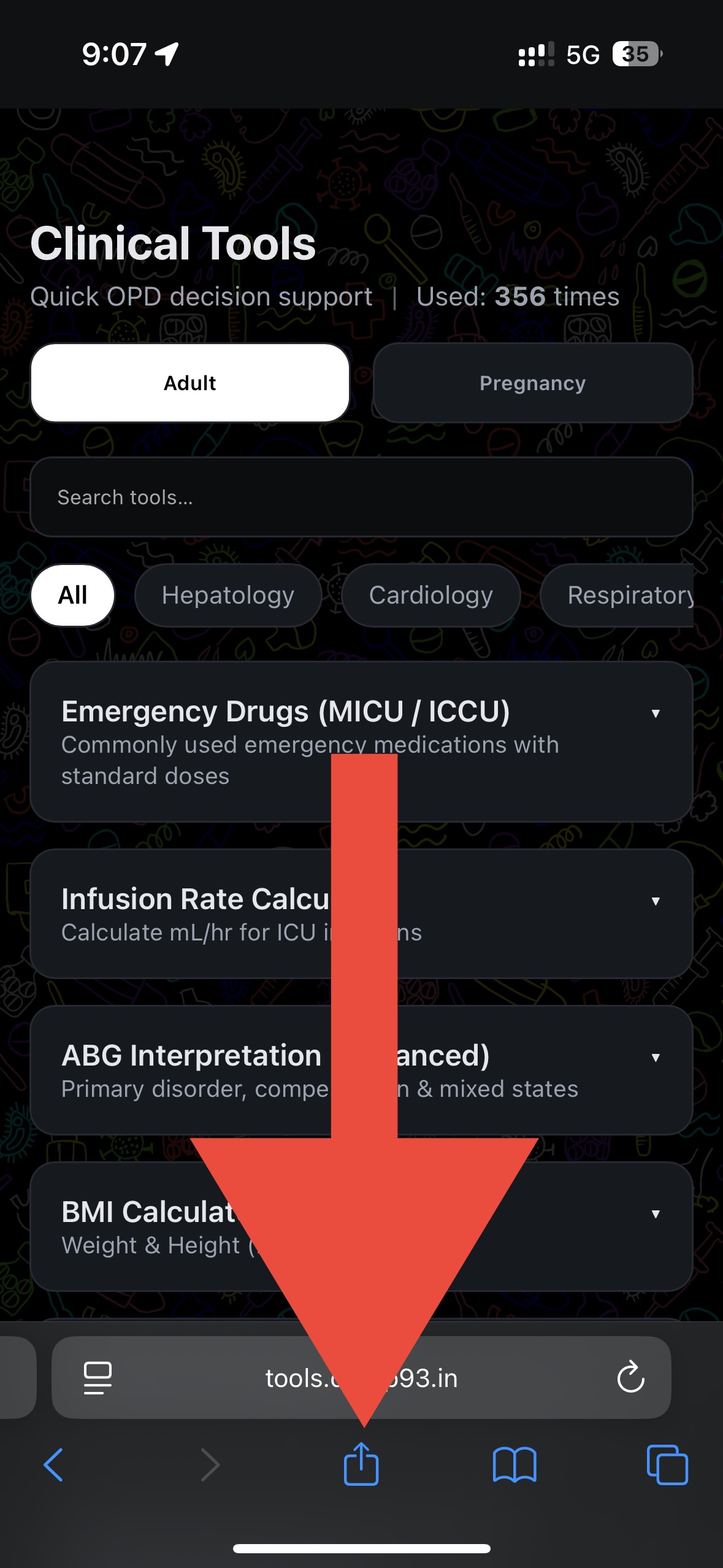
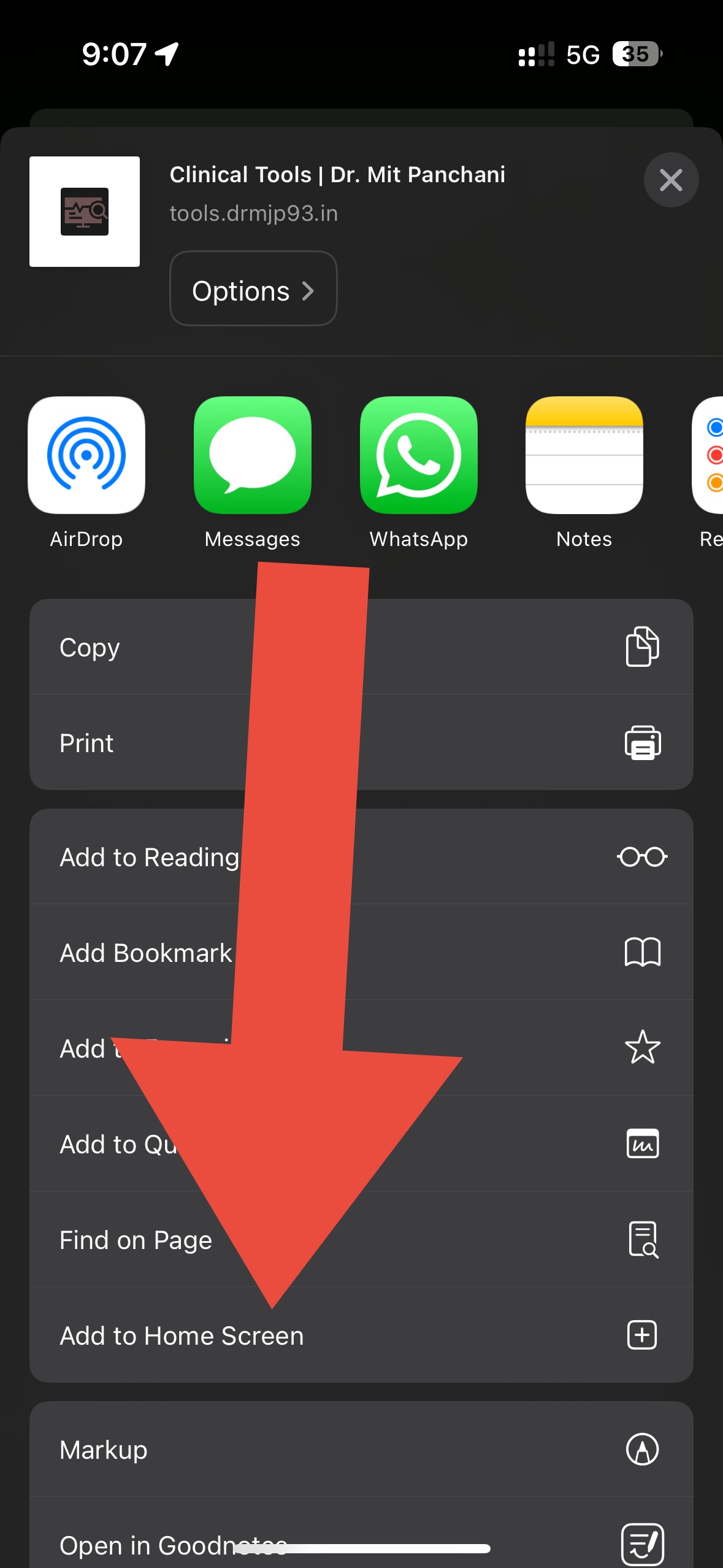
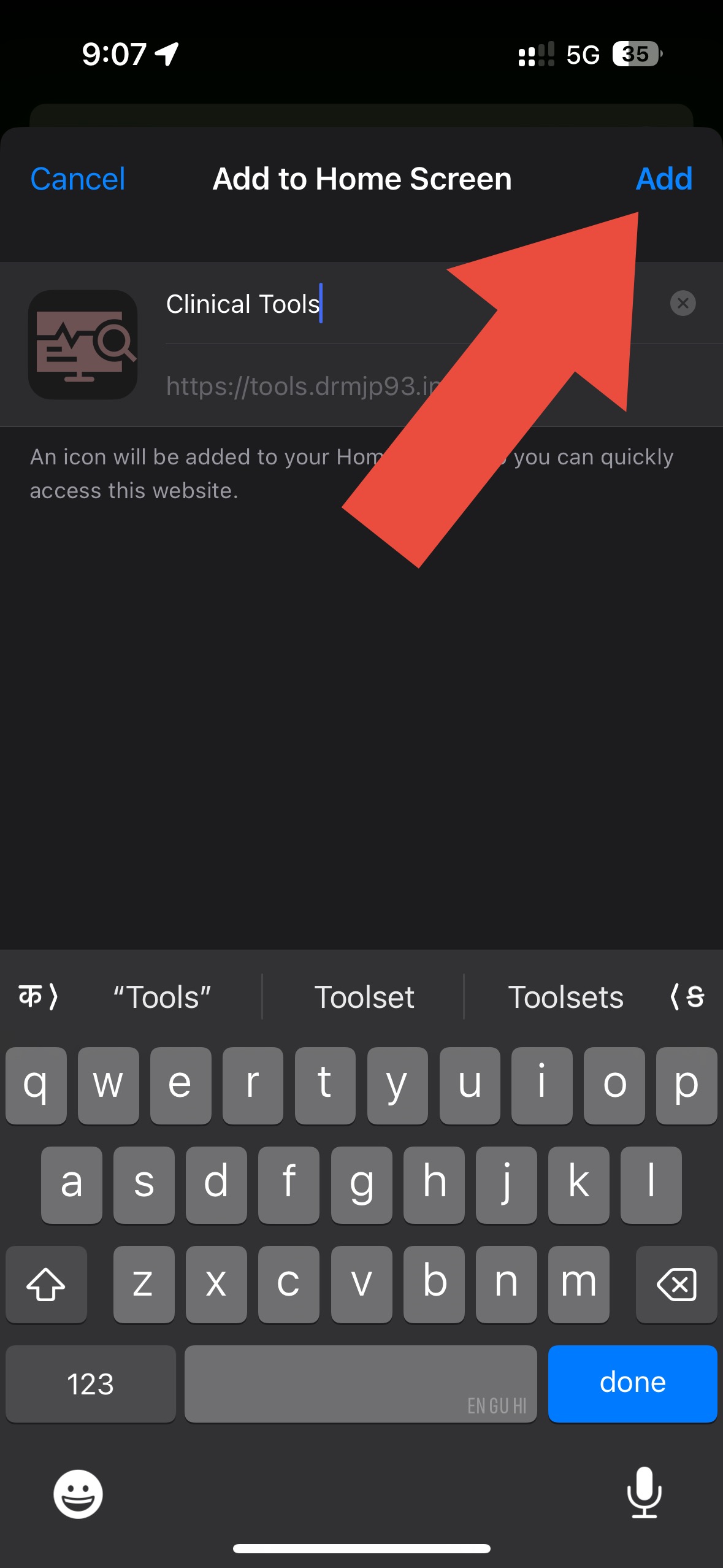
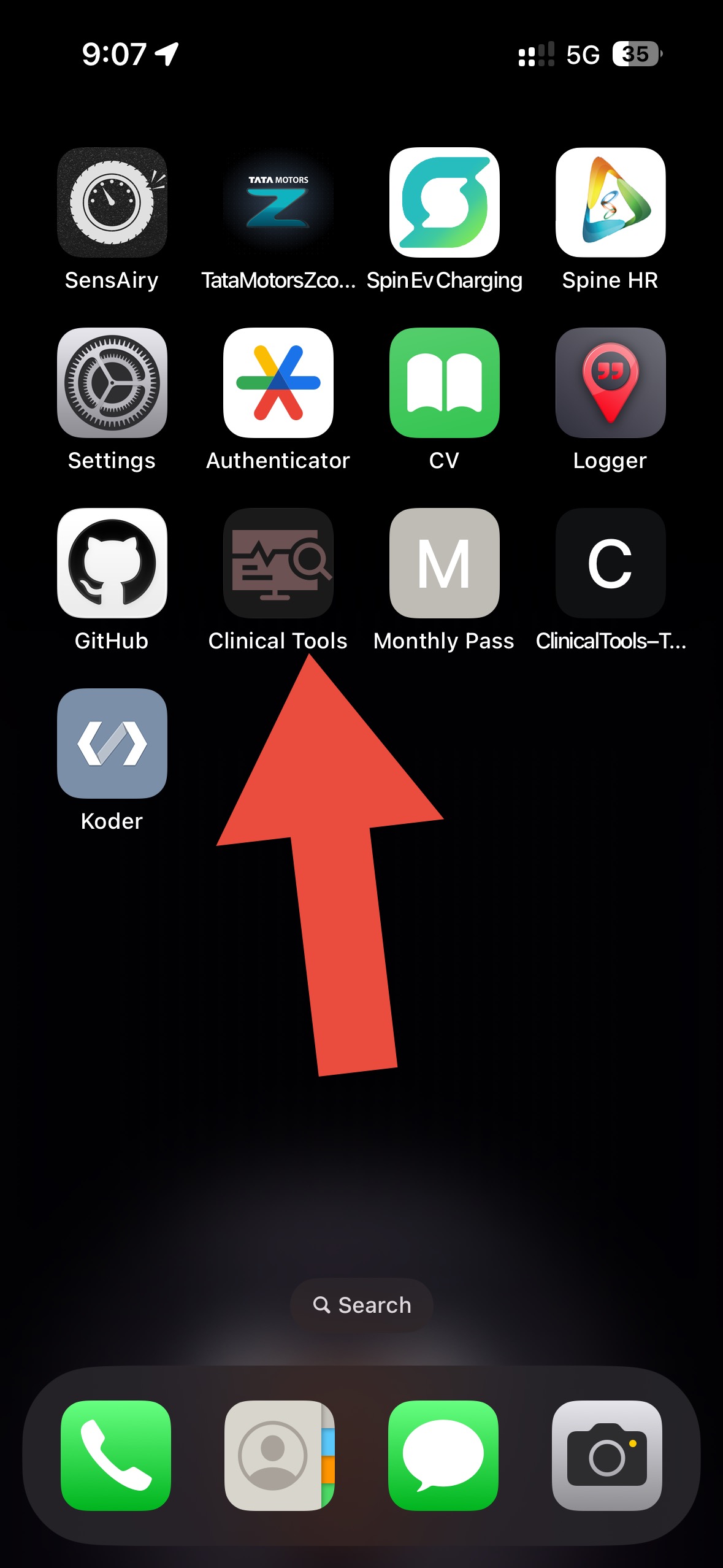
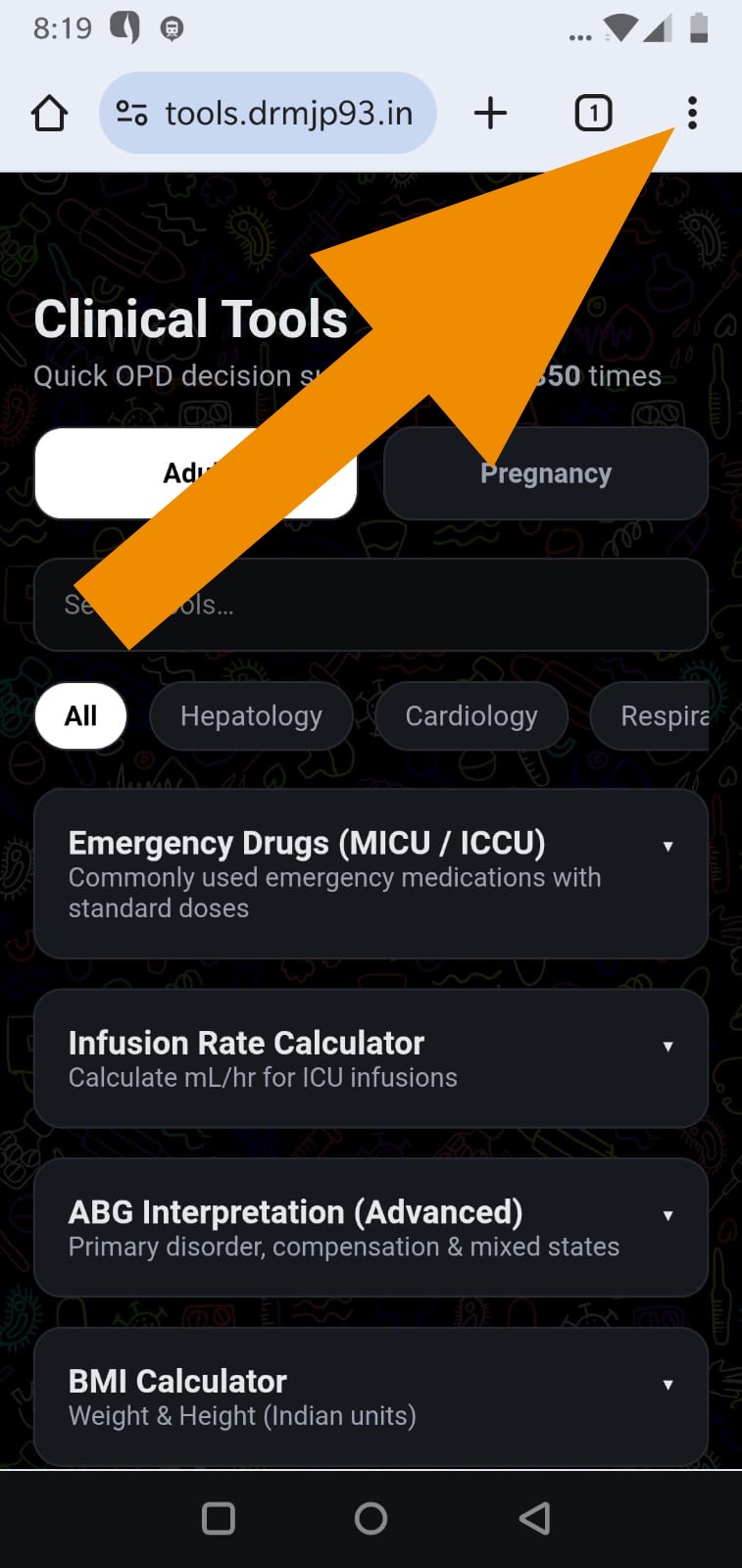
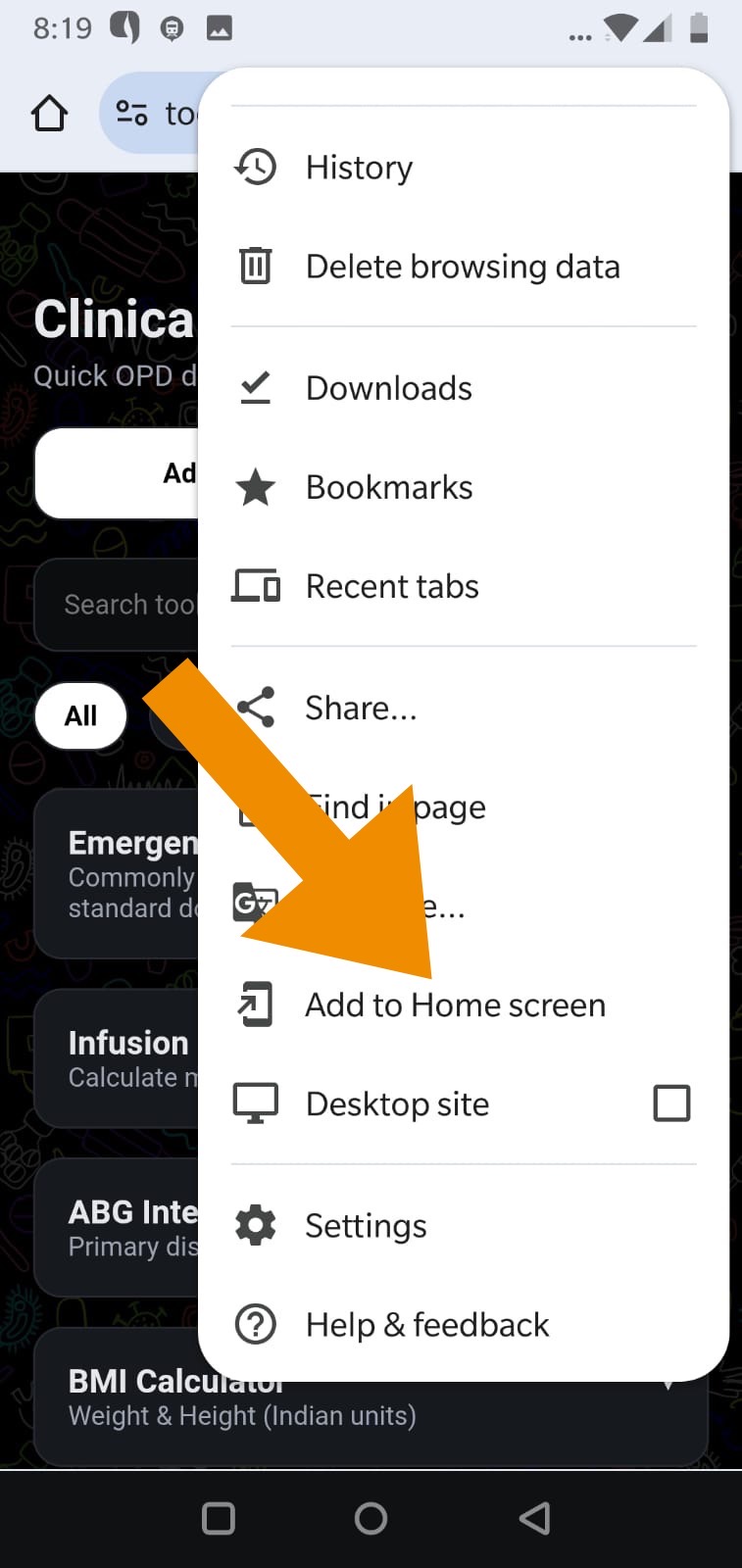
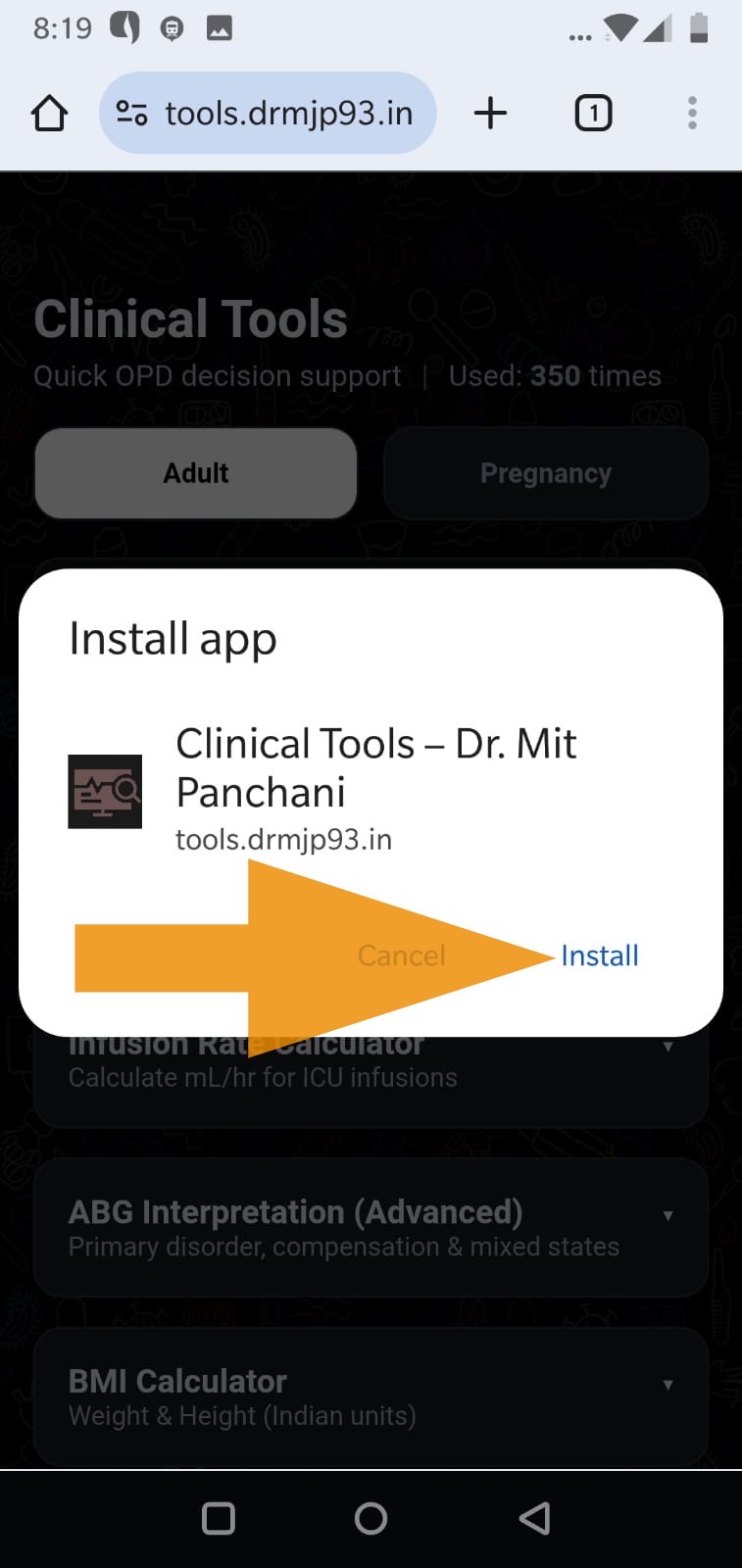
Install as App
Add Clinical Tools to your home screen
▾
Install as App
Add Clinical Tools to your home screen

Iron Requirement Calculator (IDA)
Ganzoni formula · Adult & Pediatric
▾
Iron Requirement Calculator (IDA)
Ganzoni formula · Adult & Pediatric
Patient category
Sex
Clinical details
Formula:
Iron (mg) = Weight × (Target Hb − Actual Hb) × 2.4 + Stores
Assumptions:
• Adult target Hb: Male 15 · Female 14
• Pediatric target Hb: 13
• Stores: Adult 500 mg · Pediatric 15 mg/kg (max 500)
Practical caps:
• Adult: max 1500 mg per course
• Pediatric: max 20 mg/kg
Iron (mg) = Weight × (Target Hb − Actual Hb) × 2.4 + Stores
Assumptions:
• Adult target Hb: Male 15 · Female 14
• Pediatric target Hb: 13
• Stores: Adult 500 mg · Pediatric 15 mg/kg (max 500)
Practical caps:
• Adult: max 1500 mg per course
• Pediatric: max 20 mg/kg
RBS Sliding Scale Insulin (IPD)
6-hourly · Regular Insulin · Adult (0–4–6–8–12–16–20 scale)
▾
RBS Sliding Scale Insulin (IPD)
6-hourly · Regular Insulin · Adult (0–4–6–8–12–16–20 scale)
Protocol (Adult IPD · India):
≤ 150 0 units
151 – 200 4 units
201 – 250 6 units
251 – 300 8 units
301 – 350 12 units
351 – 400 16 units
> 400 20 units + Call
Enter Random Blood Sugar (mg/dL)
Assumptions:
• Patient is off OHA, no basal insulin.
• CKD excluded (requires dose reduction).
• Use Regular insulin (SC).
Safety:
• RBS < 70: Stop insulin, treat hypoglycemia.
• RBS > 400: Check ketones, evaluate for sepsis/steroid effect.
• Patient is off OHA, no basal insulin.
• CKD excluded (requires dose reduction).
• Use Regular insulin (SC).
Safety:
• RBS < 70: Stop insulin, treat hypoglycemia.
• RBS > 400: Check ketones, evaluate for sepsis/steroid effect.
Drug Directory
Search Content / Brand · Prices · Strengths · Max Dose
▾
Drug Directory
Search Content / Brand · Prices · Strengths · Max Dose
ⓘReference information only. Doses shown are standard adult doses.
Cross-check before prescribing in high doses, elderly patients,
renal/hepatic impairment & pregnancy.
Follow-Up Date Calculator
▾
Follow-Up Date Calculator
Hepatitis B in Pregnancy
Vertical transmission prevention
▾
Hepatitis B in Pregnancy
Vertical transmission prevention
HBV DNA